
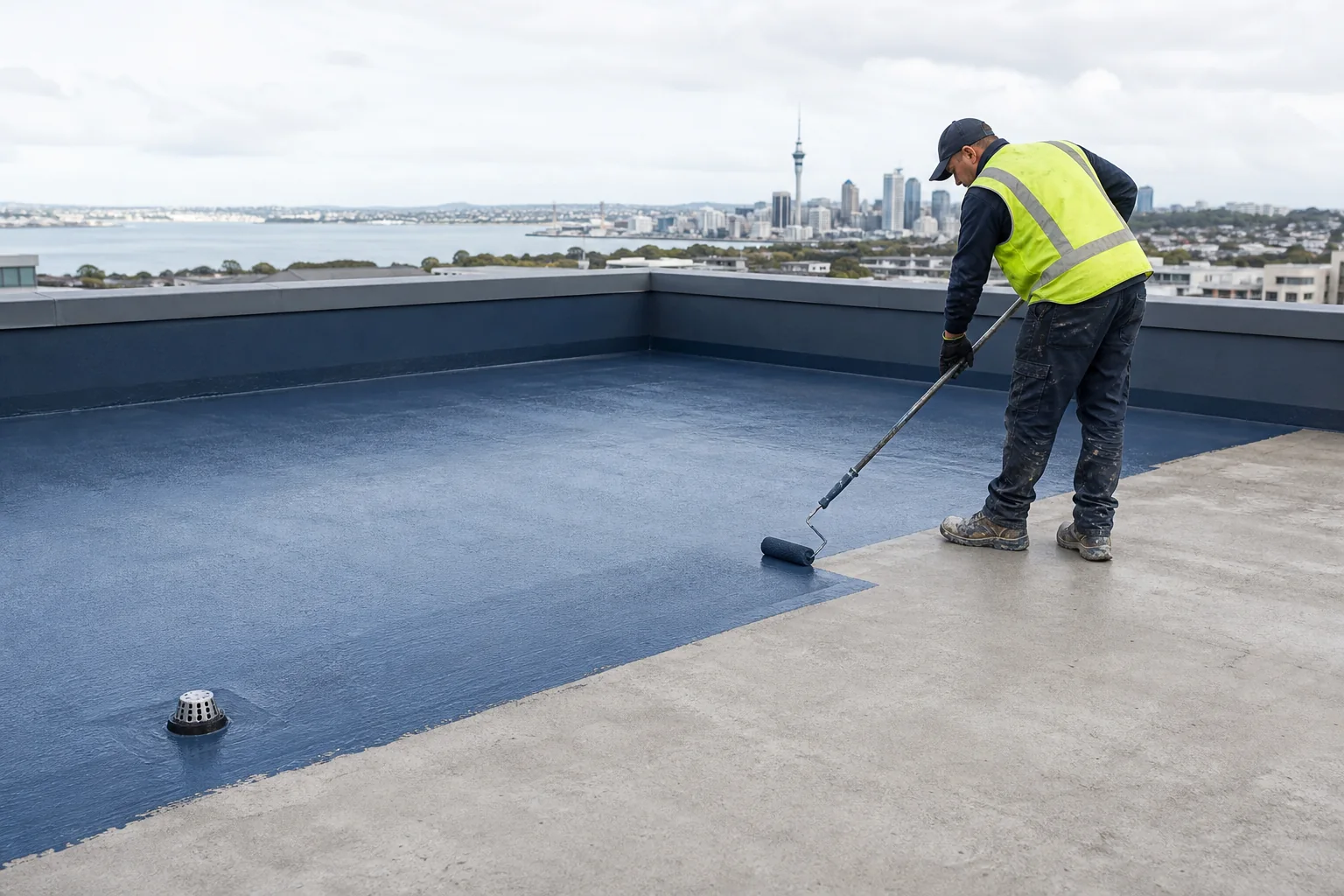
Waterproofing guide
Membrane Waterproofing in Auckland: Types, Uses and What Makes a System Last
A practical guide to liquid, sheet, rubber and bitumen membrane systems for roofs, decks, wet areas and below-ground structures.
A waterproof membrane is a continuous barrier designed to keep water out of the building elements it protects. It may arrive as a sheet, be rolled or sprayed on as a liquid, or form part of a reinforced bitumen system. The material matters, but lasting performance depends just as much on the substrate, drainage, detailing and quality of installation.
What is membrane waterproofing?
Membrane waterproofing creates a water-resistant or waterproof layer over a surface such as concrete, plywood, screed or masonry. Once the system is complete, water should be directed to the intended outlet instead of reaching the structure below.
It is more useful to think of a membrane as a complete system rather than a standalone product. Primers, bond breakers, reinforcing fabric, flashings, outlets, sealants, fixings and protective finishes may all be part of that system. Changing one component or skipping one detail can affect the result.
Where are waterproofing membranes used?
Roofs
Low-slope and flat roofs need a continuous weatherproof layer, well-planned falls and carefully detailed penetrations and outlets.
Decks and balconies
These areas combine weather exposure, foot traffic and numerous junctions. Trafficable finishes must be compatible with the membrane below.
Basements and retaining walls
Below-ground systems protect concrete or masonry from moisture in the surrounding soil and usually need protection before backfilling.
Bathrooms and other wet areas
Internal membranes sit behind or beneath the finished surface around showers, baths, laundries and other areas exposed to regular water.
The main membrane types
Each family has useful strengths, but the categories overlap and individual products have their own limitations. Current technical data should always take priority over a general description.
| System | Often used for | Key strengths | Key considerations |
|---|---|---|---|
| Liquid-applied | Roofs, decks, wet areas and complex shapes, depending on the product | Seamless finish and good access around corners, outlets and penetrations | Film thickness, curing conditions, reinforcement and substrate preparation must be controlled |
| Synthetic rubber sheet | Roofs, gutters, decks and some below-ground applications | Flexible, durable sheet with established detailing systems | Seams, adhesives, penetrations and upstands require disciplined workmanship |
| Thermoplastic single-ply | Commercial and residential roofs and selected deck systems | Lightweight sheets with heat-welded seams and useful detailing accessories | Installation normally requires trained applicators and compatible substrates and components |
| Reinforced bitumen | Flat roofs, decks, podiums and below-ground work | Robust multi-layer options and good resistance to demanding conditions | Heat-applied systems introduce fire risk; terminations and protection layers are critical |
| Cementitious or polymer-modified | Concrete tanks, foundations, wet areas and protected surfaces | Compatible with mineral substrates and useful in selected positive- or negative-side applications | Movement capability and exposure limits vary; it may not suit an exposed flexible structure |
This is a general comparison, not a product specification. Product scope, substrate, exposure, drainage and compliance documentation must be checked for each project.
Why the details decide whether a membrane lasts
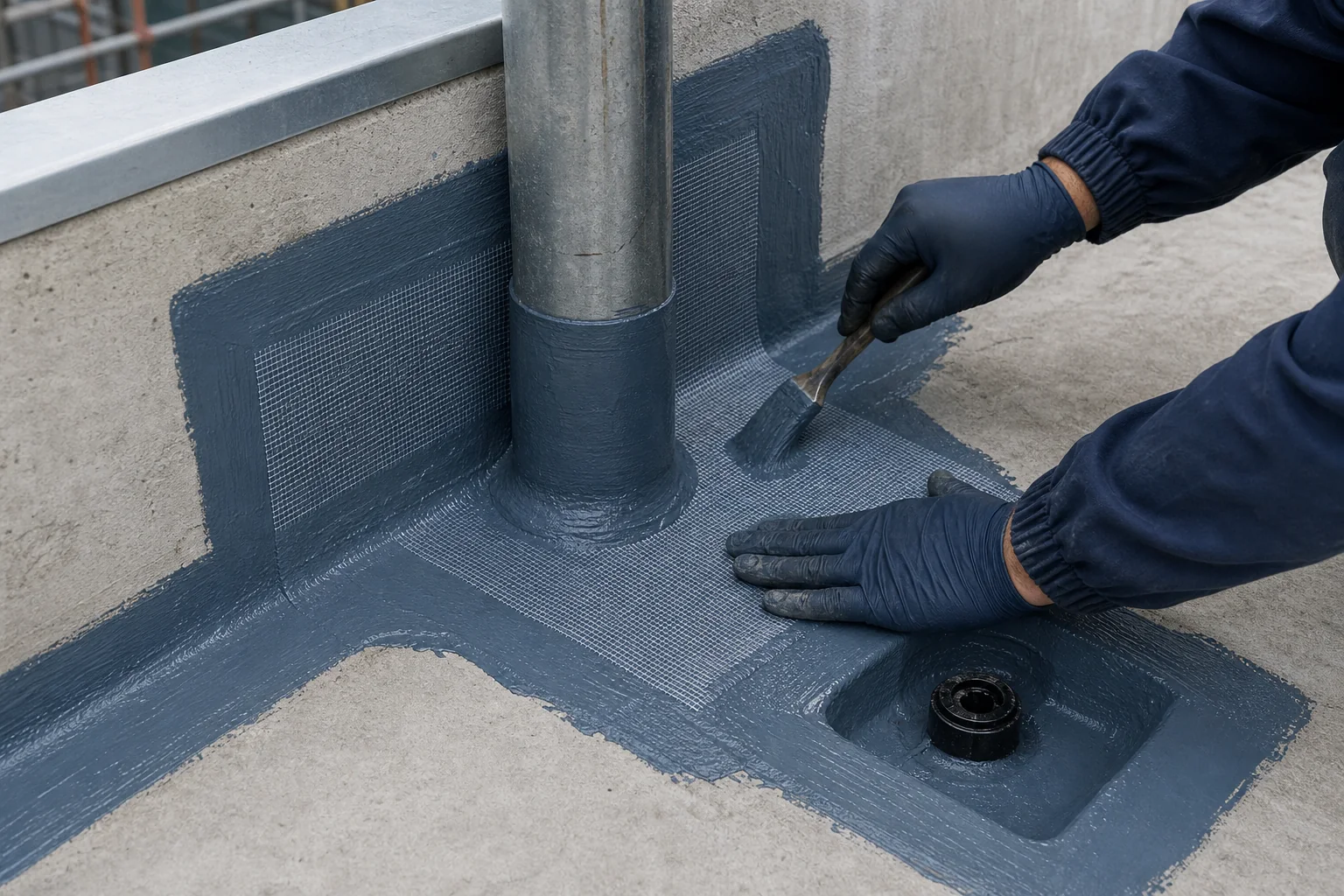
Large open areas are often the simplest part of a waterproofing job. The greater risk sits at changes in direction and places where other building elements meet the membrane.
- Outlets and overflows: water needs a reliable path off the surface, with the membrane securely connected to the drainage fitting.
- Upstands and parapets: the membrane must rise high enough and terminate under a suitable flashing or protected edge.
- Penetrations: pipes, vents, posts and fixings interrupt the field membrane and need system-compatible detailing.
- Movement joints and corners: changes in plane may need reinforcement or a detail that can tolerate movement.
- Transitions: door thresholds, cladding junctions and connections to another waterproofing material need a clear, compatible sequence.
How to choose the right membrane system
A useful specification starts with the building conditions, not a favourite brand. These are the questions that narrow the options.
- Where is the membrane going? An exposed roof, tiled shower, trafficable deck and buried retaining wall present very different demands.
- What is the substrate? Concrete, plywood, fibre-cement sheet and existing membranes move and absorb moisture differently.
- How will water drain? Falls, outlet size and overflow provision should be resolved before membrane installation.
- How much movement is expected? Sheet joints, structural movement and thermal cycling influence the required flexibility and detailing.
- What exposure will it face? Auckland UV, wind-driven rain, salt-laden air, shade and ponding risk can all affect selection.
- What evidence supports its use? Review the current technical data, installation instructions, appraisal or certification, and the proposed Building Code compliance pathway.
- Who is approved to install it? Some manufacturers require trained or licensed applicators for system warranties.
What professional membrane installation involves
- Survey and moisture diagnosis. The installer identifies the water source, checks falls and outlets, and examines the supporting structure. Applying a new membrane without resolving the cause can trap the original problem.
- System and detail selection. The chosen system is matched to the substrate and exposure. Junctions, penetrations, terminations and drainage details are planned before work begins.
- Substrate preparation. The surface is cleaned, dried and repaired to the standard required by the manufacturer. Sharp edges, cracks, loose material and incompatible coatings are addressed.
- Priming and detailing. Compatible primers, bond breakers, tapes or reinforcing materials are installed in the correct sequence.
- Membrane installation. Sheets are bonded and joined, or liquid coats are applied to the required coverage and thickness. Weather windows and cure times are respected.
- Inspection and handover. Critical details are checked, defects are corrected, and the client receives relevant product, warranty and maintenance information. Progress photographs can provide a useful record of concealed work.
New Zealand compliance: match the system to the location
The New Zealand Building Code separates external moisture and internal moisture. Roofs, decks and below-ground walls sit within an external-moisture context, while bathrooms and similar internal wet areas are addressed under Clause E3.
For internal wet areas, E3/AS2 cites the Waterproofing Membrane Association code of practice, and AS/NZS 4858 covers wet-area membrane materials. Those references should not be treated as a blanket approval for an exposed roof or deck membrane.
For any project, the designer, installer and building consent authority may need product-specific evidence showing that the complete proposed system is suitable. A recognised appraisal can help establish scope and conditions, but its limits still matter. For example, BRANZ publishes current appraisals for systems including Butynol and Butyseal and selected thermoplastic membranes.
Questions to ask a waterproofing contractor
- Is this system intended for my exact application and substrate?
- What current technical documents support the proposed use?
- How will outlets, overflows, thresholds, penetrations and wall junctions be detailed?
- How will the existing substrate and any trapped moisture be assessed?
- Are you approved or trained by the system manufacturer?
- What weather conditions and curing time does the installation require?
- What workmanship and product warranties apply, and what could invalidate them?
- Will I receive photographs, product records and a maintenance schedule at handover?
Maintenance and early warning signs
Membranes need maintenance even when they are hidden below a finish. Keep outlets clear, avoid unapproved fixings through the system and inspect exposed roofs or decks after severe weather. Arrange an assessment if you notice blistering, splits, lifting seams, cracked sealant, persistent ponding, damaged flashings, musty odours or staining below the waterproofed area.
Finding a small defect early is usually less disruptive than waiting for water to damage insulation, framing, linings or finishes.
Frequently asked questions
How long does a waterproof membrane last?
There is no universal lifespan. Product type, exposure, substrate movement, drainage, workmanship and maintenance all affect service life. Use the current manufacturer information for the selected system and inspect it at the recommended intervals.
Can a new membrane go over an old one?
Sometimes, but only after the old system and substrate have been assessed. Compatibility, adhesion, trapped moisture, falls, weight and existing defects must be considered. Covering a failed membrane without diagnosing it may hide rather than solve the problem.
Is a waterproof coating the same as a membrane?
Not automatically. Some liquid-applied products form tested membrane systems when installed at the specified thickness with their required components. A generic surface coating may not provide the same crack-bridging, detailing or compliance evidence.
Can membrane waterproofing be a DIY job?
Small maintenance tasks may look straightforward, but membrane performance depends on hidden preparation and technical details. Consent work, difficult junctions, occupied buildings and manufacturer-warranted systems are best handled by suitably experienced professionals.
What does membrane waterproofing cost in Auckland?
Cost depends on access, area, substrate repairs, drainage work, detailing, membrane type and the finish above it. A site inspection and a clearly defined scope are more meaningful than a square-metre rate that excludes preparation and junction work.
Need help choosing a membrane system?
A2Z Waterproofing can assess the substrate, exposure and problem details, then recommend a system suited to the job. Talk to our Auckland team about roofs, decks, wet areas or below-ground waterproofing.